
Marine oils
-
-
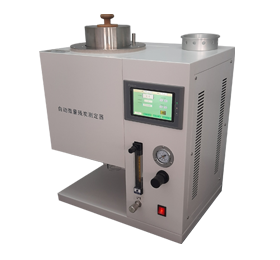
KN-4530 Micro Carbon Residue Apparatus
The carbon residue value of the various petroleum materials serves as an approximation of the tendency of the material to form carbonaceous type deposits under degradation conditions similar to those used in the test method, and can be useful as a guide in manufacture of certain stocks. However, care needs to be exercised in interpreting the resultsRead
more >
-
-
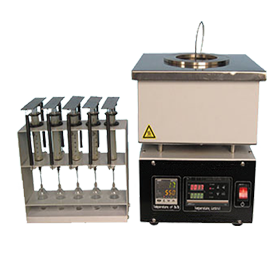
KN-524 Ramsbottom Carbon Residue Apparatus(Electric furnace method)
The carbon residue value of burner fuel serves as a rough approximation of the tendency of the fuel to form deposits in vaporizing pot-type and sleeve-type burners. Similarly, provided alkyl nitrates are absent (or if present, provided the test is performed on the base fuel without additive) the carbon residue of diesel fuel correlates approximately with combustion chamber deposits.
The carbon residue value of motor oil, while at one time regarded as indicative of the amount of carbonaceous depRead
more >
-
-
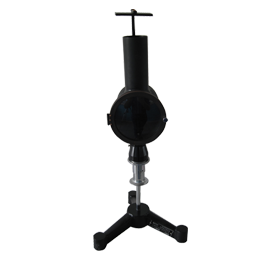
KN-1322 Smoke Point Apparatus for Kerosene
The smoke point is related to the hydrocarbon type composition of such fuels. Generally the more aromatic the fuel the smokier the flame. A high smoke point indicates a fuel of low smoke producing tendency.Read
more >
-
-
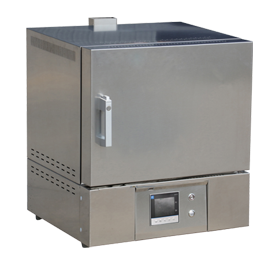
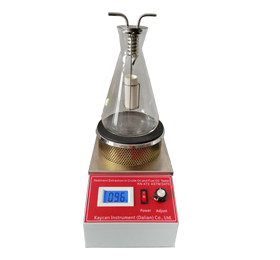
KN-482 Ash Content for Petroleum Product
Knowledge of the amount of ash-forming material present in a product can provide information as to whether or not the product is suitable for use in a given application. Ash can result from oil or water-soluble metallic compounds or from extraneous solids such as dirt and rustRead
more >
-
-
KN-473 Sediment Extraction in Crude Oil and Fuel Oil
A knowledge of the sediment content of crude oils and fuel oils is important both to the operation of refining and the buying or selling of these commoditiesRead
more >
-

-
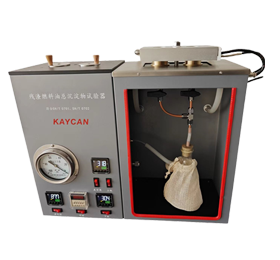
KN-665 Rusting Characteristics of Oils
In many instances, such as in the gears of a steam turbine, water can become mixed with the lubricant, and rusting of ferrous parts can occur. This test indicates how well inhibited mineral oils aid in preventing this type of rusting. This test method is also used for testing hydraulic and circulating oils, including heavier-than-water fluids. It is used for specification of new oils and monitoring of in-service oilsRead
more >
-
-
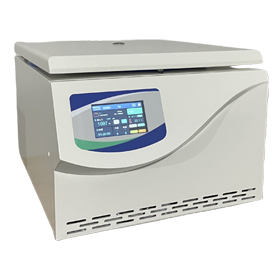
KN-4870 Total Sediment in Residual Fuels
Appreciable amounts of sediment in a residual fuel oil can cause fouling of facilities for handling, and give problems in burner mechanisms. Sediment can accumulate in storage tanks, on filter screens, or on burner parts, resulting in obstruction of the flow of oil from the tank to the burnerRead
more >
-
-
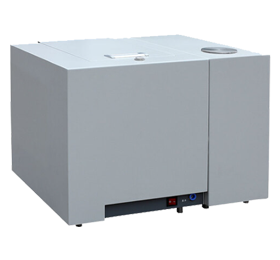
KN-1796 Oil Test Centrifuge
The water and sediment content of fuel oil is significant because it can cause corrosion of equipment and problems in processing. A determination of water and sediment content is required to measure accurately net volumes of actual fuel oil in sales, taxation, exchanges, and custody transfers.Read
more >
-
-
KN-5865 Automatic Calorimeter
The gross calorific value can be used to compute the total calorific content of the quantity of coal or coke represented by the sample for payment purposes.
The gross calorific value can be used for computing the calorific value versus sulfur content to determine whether the coal meets regulatory requirements for industrial fuels.
The gross calorific value can be used to evaluate the effectiveness of beneficiation processesRead
more >
-
-
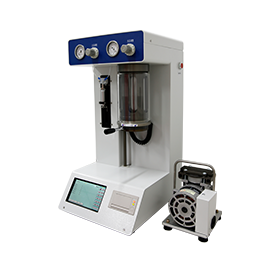
KN-4406 Oil Particle Counter
this oil particle counter equip with Built-in ISO4406,GB/T14039, NAS1638, JBT9737.1, SAE749D, GJB420A,GJB420B, DL/T1096 particulate contamination level standards and user-defined particle channel settings; can built-in required standard according to user requirements;Read
more >

 No.88 Xin Shuini Road, Ganjingzi District, Dalian, Liaoning Province
 Mobile:+86-13889520862 Email:jimmychou@kaycantest.com; info@kaycantest.com